When it comes to ancient caves in India known for their historic or prehistoric significance, the first names that come to one’s mind are Ajanta, Ellora, Elephanta or Bhimbetka. Most of these better known caves are UNESCO World Heritage Sites now and find place in every traveller’s bucket list. However, there are many such caves in India which are lesser known and unnoticed, yet they will sweep you off your feet with their beautiful sculptures, carvings and incredible rock cut architecture. The remnants, that are now carefully preserved and guarded by the Archaeological Departments of the Centre and the States, quietly whisper the saga of their splendid past.
The caves in Vijaywada, Andhra Pradesh were one such discovery. Until I visited this place, I had no idea that this city had three captivating ancient rock cut caves.
Undavalli Caves, Akkanna Madanna Caves and Mogalrajapuram Caves are the three caves which form an intriguing circuit in Vijaywada. All three are being maintained and protected by the Archaeological Survey of India and have been declared as monuments of national importance.

Ensconced beautifully on the banks of Krishna River, Vijaywada is surrounded by pristine hills of Eastern Ghats. During winter months, these hills are covered with dense fog in early morning hours. The rising sun plays hide and seek with the clouds, grins naughtily and disperses its orangish hues all over. The sunrise that I saw in Vijaywada while visiting the Kanak Durga temple was one of a kind. It appeared as if the sun was rising from nowhere, like a golden ball hanging in the air without a thread.

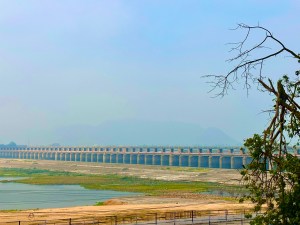
The second largest city of Andhra Pradesh, Vijaywada is largely known for the Prakasam Barrage on Krishna river built by the British and later named after the first Chief Minister of Andhra Pradesh, Mr. T. Prakasam.
It is also considered a sacred place for Hindus for being home to an important temple of Goddess Durga along with many other important shrines. Kanaka Durga temple and Lakshmi Narasimha temple are two most frequented temples in the town making it an important religious centre.
Out of the three caves in the town, Undavalli cave temple is the most impressive of all. Located on the outskirts of Vijaywada town, this cave temple is mostly thronged by the locals especially on weekends and holidays. Very few people from outside Andhra Pradesh are aware of the presence of this four storey magnificent cave temple here. In fact, it took me quite some time to memorise the name of this cave as I had never even heard of it.

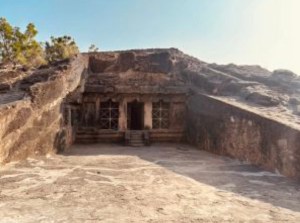
Undavalli cave temple has been carved out of a monolith rock in four layers. Dating back to the 4th-5th century CE, this temple is nothing less than a visual treat for a traveller.
Out of the four storeys, the ground and first floors have unfinished pillared halls. The most remarkably crafted is the second floor of the cave temple where sculptures represent various Hindu deities.

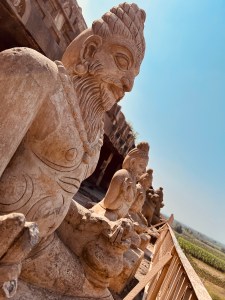
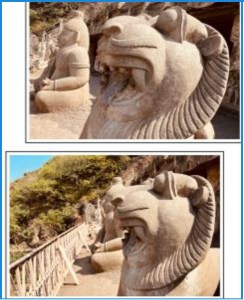
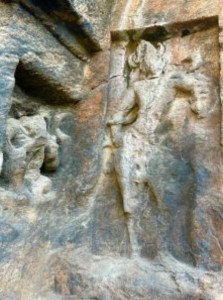
The cave temple’s second floor has intriguing sculptures of Rishis (sages) and lions which I have never seen elsewhere. The Rishis are sitting with their back to the temple and overlooking the hills ahead. The lions have ferocious disposition from the front and a comical appearance from the sides. The sculptures and carvings at Undavalli have spectacular finesse.
The sanctum at the end of the majestic second floor corridor houses a large idol of Ananthashayana Vishnu ( Vishnu in reclining position) with his eyes wide open and a seven head snake guarding it.
However many argue that the idol is not of Vishnu as the well accepted features of Anantshayana Vishnu are missing.


Like most of such sites in the country, Undavalli was also subjected to religious rivalry. There has been claims that the idol of reclining Vishnu may be of some Jain Tirthankar for reasons such as the absence of idols of Shridevi and Bhoodevi and five head serpent called Adi Shesha. The idols of reclining Vishnu in Hindu temples always have their eyes closed, traditionally but that is not the case here.
Whatever may be the truth, the absorbing beauty of this cave temple certainly makes it a place worth visiting.
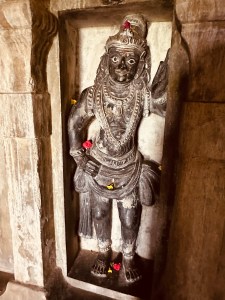
There are smaller hills of Eastern Ghats in Vijaywada which are known by various names like Mangalgiri, Indrakeeladri hills, and Mogalrajapuram hills etc.
The second cave temples called Akkanna Madanna lie in the foothills of Indrakeeladri mountain near Kanaka Durga temple. There are two sections of these caves called Upper and Lower caves. While the Lower caves can be approached directly from the road, one has to climb 50 steps to reach the Upper caves.
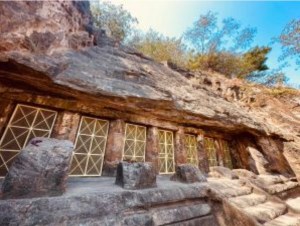

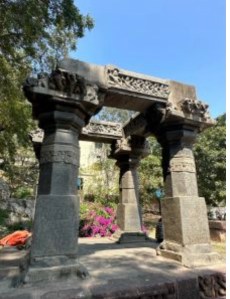
These are a group of rock cut Hindu cave temples which date back to 7th century. Not much historical accounts are available about these structures, however upper caves have some inscription pillars which helped establishing the period of these caves. There is a small park between Upper and Lower caves where remnants of the excavated ruins from nearby temples have been showcased. The most remarkable of all is an inscribed granite mandapa placed aesthetically in the garden.
Interestingly, the caves today are known by the names of two Brahmin brothers Akkanna and Madanna who served as ministers in 17th century Qutubshahi dynasty of Golkonda. The legend of the brothers still lives in the hearts of the people of Andhra and Telangana.
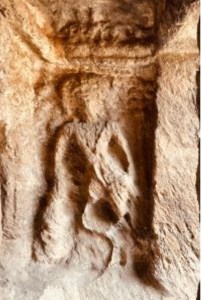

Crescent in shape, the third set of caves in Vijaywada are called Mogalrajapuram caves which can be seen at two places within a distance of two kms. There are no idols inside the cave temples and very little of iconography and artwork remains today. One can only see pillared halls at both the places.
The caves are said to be dedicated to Shiva and were built around 7th century CE.
Whatever little remains today of the past grandeur is good enough to sing praises of a time when these cave temples were the lifeline of the city much like the Kanak Durga temple is today.

In a country like India buzzing with rich culture, countless places of pilgrimage, radiating monuments, thriving modern cities and towns and a plethora of nature all around, Vijaywada offered a medley of everything on a platter, an assortment of unceasing life for centuries together making it an endlessly fascinating city.
For a traveller, such discoveries are quite rewarding. One wonders what inspired people to create such master pieces with chisels and hammers. Most of the craftsmen might not have even lived to see the outcome of their hard work in their lifetime. It was the vision which the patron kings and queens had that culminated in the creation of something to last for centuries.


 The Mishdi Chronicles
Leave a comment