Considering the rich architectural history of India, spanning over 2000 years and nicely woven in the thread of various religions followed in this country, India can safely be called a ‘country of temples‘. However, in this vast country, a few cities and towns have emerged tall and held to their credit, a beautiful cluster of temples. These places rightly deserved to be called the temple cities of India. To name a few, Kanchipuram and Kumbakonam in Tamilnadu, Varanasi in Uttar Pradesh, Bishnupur in West Bengal, Maluti in Jharkhand and Bhubaneshwar in Odisha rose to the ultimate fame for two reasons. Firstly, these towns witnessed a continuous architectural growth over a long period of time and secondly, a majority of this heritage is still preserved as testimony to the glory of the bygone era.
Bhubaneshwar, the capital city of Odisha, is one such prominent temple city of India. Very few of us are aware that this city has carefully concealed various centuries old temples, tanks and other monuments, documenting almost the entire history of the Kalinga empire and subsequent regimes from the 3rd century BC to the 15th century AD and only the discerning eye could unravel the mystery behind this treasure trove.
This magnificent and impressive cluster of temples lies in ‘Ekamra Kshetra’ which comprises of the area of the old Bhubaneshwar city. Lingaraj temple is the most imposing of all the temples in this cluster. Needless to say, but many of us who visit Bhubaneshwar, are unaware of this rich cultural and architecture repository of the city and miss out on a lot of significant sites. The routine circuit that the religious tourism follows, starts from Lingaraj temple at Bhubaneshwar and ends at Shri Jagannath temple at Puri via Konark Sun temple and Dhauli.
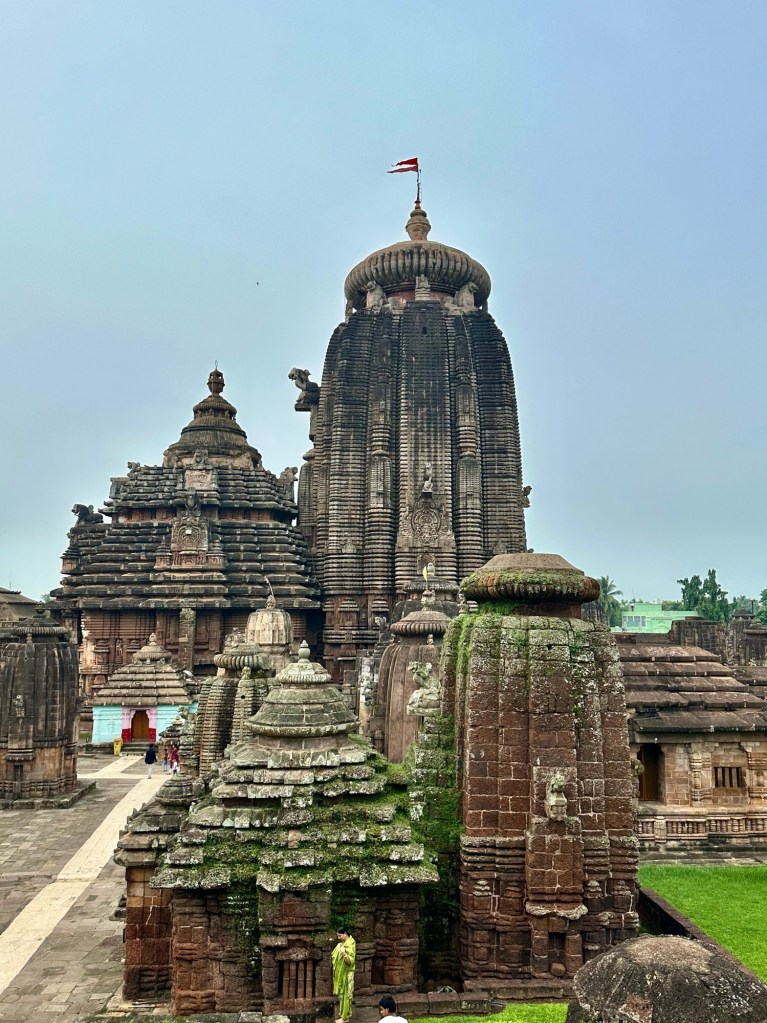
Another surprising element about the ‘Ekamra Kshetra’ is that almost all the temples are live Hindu temples where daily pujas are performed with the strictest ritualistic order.
It was a rainy season in the State and a generally hot and humid Odisha was pleasant with frequent cloud movements and breezy weather, when I planned a trip to this city. We began our day with a visit to Lingaraj temple in the early morning hours. The temple is mostly crowded during the day and to avoid the rush, we chose the early morning for our visit. As expected, the temple was very quiet as if just woken up from a slumber. As we entered the main gate and reached inside the temple, some sort of peace descended upon us. The architecture of the temple was fascinating but the aura of the temple was even more enchanting.
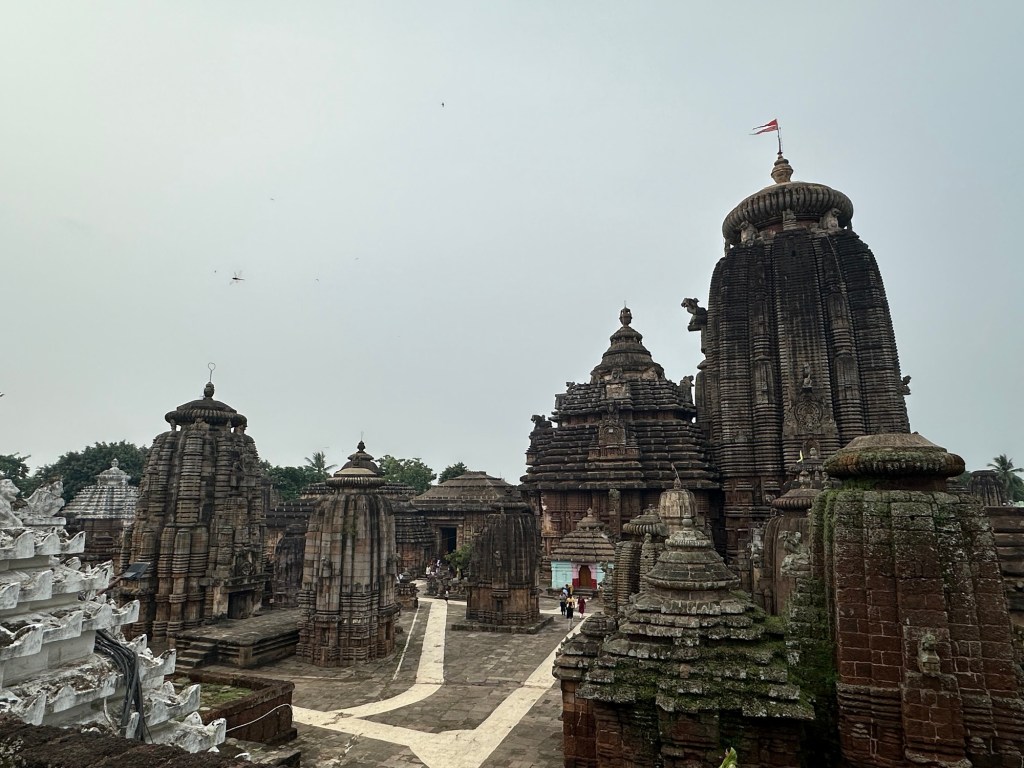
Lingaraj temple, a Hindu temple dedicated to Shiva is one of the oldest temples in Bhubaneshwar. This towering landmark of Bhubaneshwar dates back to 11th century AD, however, evidences have been found to indicate that some parts of the temple were constructed in the 6th and 7th century AD.
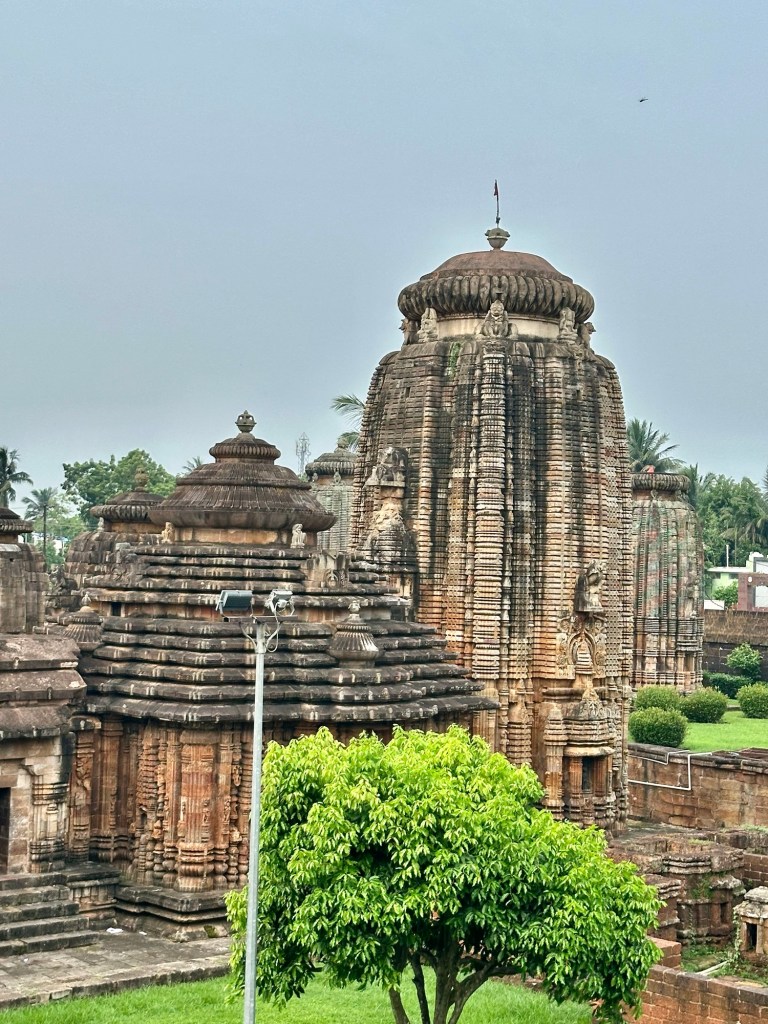
Lingaraj temple has been built in ‘Deula style’ of architecture that has four components comprising Vimana (structure containing the sanctum), Jagmohana (assembly hall), Natamandira (dance or festival hall) and Bhoga Mandapa (hall of offerings).
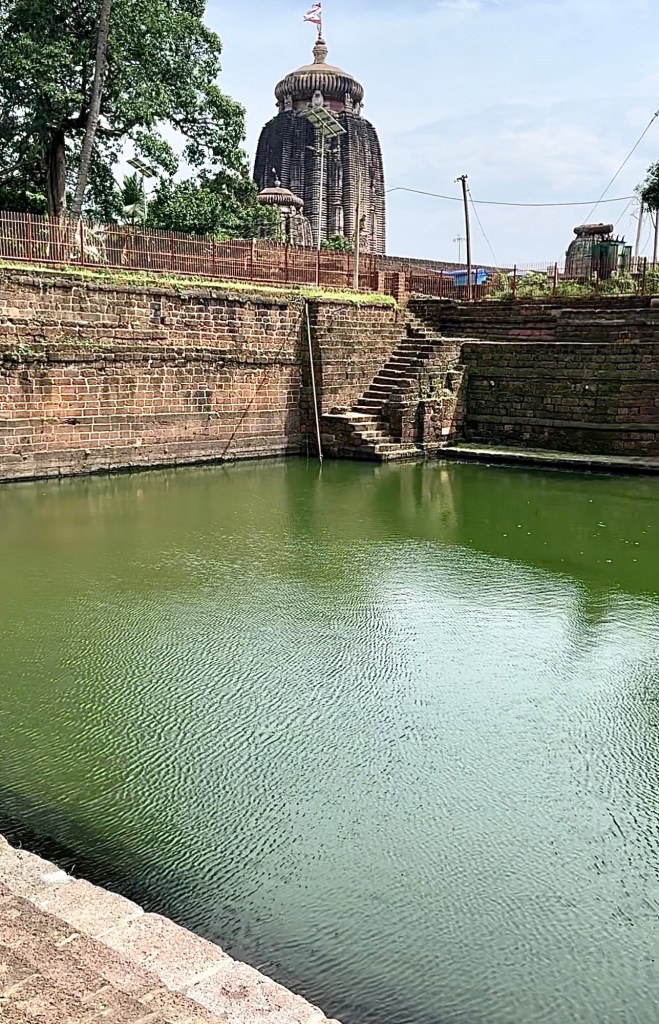
In the city of Bhubaneshwar, various tanks have been built along the walls of the temples. Such tanks and step wells are found almost everywhere in India either inside or outside the religious site and in almost all the religions. These tanks were used mostly for sacred ritual bathing and sometimes also served the purpose of water storage. Lingaraj temple lies just 100 m South of a huge tank called Bindu Sagar and between two smaller tanks called Papnashini tank and Devi Padahara tank.
Lingaraj temple is considered to be built by the Somavanshi king Yayati I during the 11th century. This magnificent temple has a major shrine dedicated to Lord Shiva and many other shrines dedicated to other deities of the Hindu pantheon. The second most important shrine in the temple complex is dedicated to the Goddess who is worshiped as Bhuvaneshwari, the consort of Shiva.
The temple follows the strictest Hindi rituals and non Hindus are not allowed inside the temple complex. For those, who are not following Hinduism, yet are curious to witness the magnificence and grandeur of the temple, a raised viewing platform called Curzon Mandap, has been built to the north compound wall of the temple, adjacent to the north gate. This north gate is perpetually closed. One can get a panoramic view of the temple only from the Curzon Mandap. The cameras and mobile phones were not allowed inside the temple, which is why there are a few photographs I could manage to click from outside. Though this restriction denied us from having a thorough glimpse of the finest architecture which is nothing less than the rich artistic heritage of this country.
The mandap got its name from an incident in the history of British India. It is said that Lord Curzon was denied entry into this temple by the local priests as he was not a Hindu. He ordered his administration to construct this viewing point. One can understand the earnest curiosity of Lord Curzon to see this glorious architecture as even today it entices its visitors dearly and basks in its vanity.
Like all other important temples in India, Lingaraj was also infested with pandas (local temple priests) with a single purpose of catching hold of the visitors and fleecing them. My driver had warned me against the pandas but I got stuck with one of them. He took me around, told numerous stories about the temple, most of which were imaginary and illogical, asked me to offer money here and there and wasted a lot of my time. At the end of it, he demanded a huge sum in the name of some puja which he was supposed to perform a few months later on an auspicious day in the name and welfare of my family. I was amused at this demand and struggled hard to wriggle out my neck from this mess. I then decided to give the same piece of advice to everyone who visited this temple as my driver gave me, which I merrily ignored. One interesting thing that this priest told me was not mentioned anywhere else that Shiva and Vishnu were worshipped together in the sanctum as Harihar. This also indicated the seamless harmony of two traditions which coexisted in Lingaraj temple. The temple had a ‘Bhogshala’ or a community kitchen, a tradition mostly followed by Vaishnavites in Odisha. Jagannathpuri is known for its Mahaprasadam as it is believed that Lord Vishnu descends to Puri for His food.
Lingaraj temple vividly transported me through the alleys of history and faith at the same time. The temple attracts everyone who is keen to know Shiva, the primordial diety. When there was nothing, there was Shiva. Since the time of Indus Valley civilisation, Shiva and Shakti have been worshiped as Pashupati and Mother Nature to uphold the seed of creation. In various civilisations across the world, the male and the female energies have been revered together. Lingaraj, literally meaning the great phallus and Bhubaneshwari, the eternal female energy of the universe reside together in this magnificent abode which defines timeless architecture of ancient India that transcends centuries.


 The Mishdi Chronicles
Leave a reply to 😊😊 Cancel reply